
Write Now Rebekah – Short Stories and Writing Life in the Netherlands
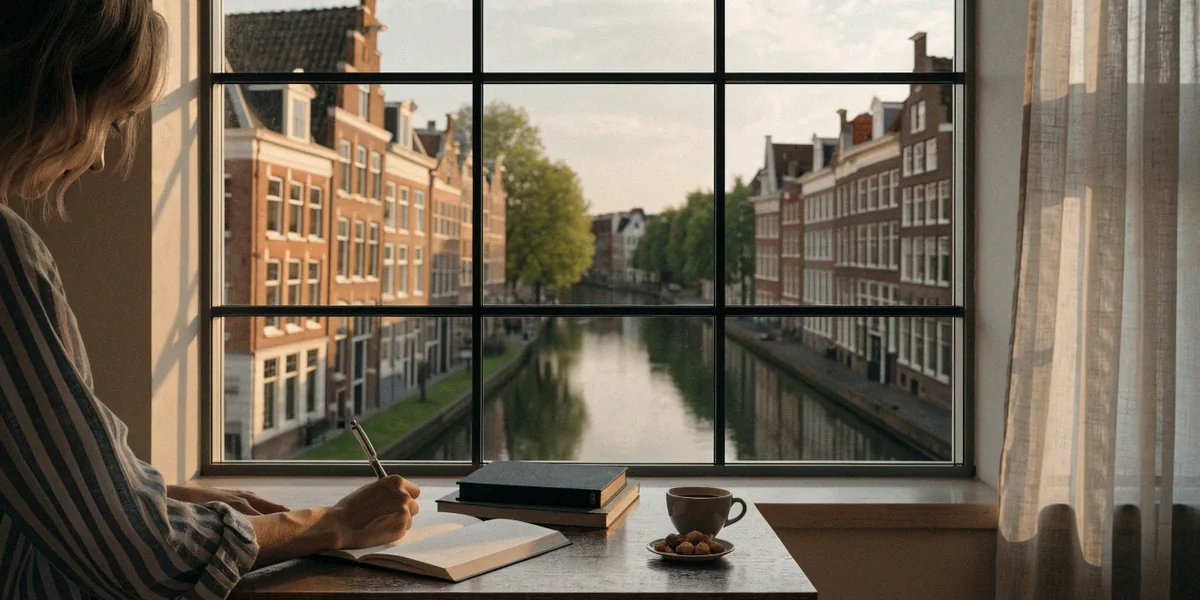
It’s a grey Tuesday afternoon in Amsterdam, and the rain is doing that soft, persistent thing it does here — not quite drizzle, not quite downpour. We’re tucked into a corner table at Café de Jaren, a cappuccino going cold beside a notebook that’s already half full of scribbles. Through the tall windows, the Amstel glints beneath a low sky, and a row of canal houses leans together like old friends sharing secrets. Somewhere between the clink of espresso cups and the hum of Dutch conversations we don’t quite follow, a sentence arrives. Then another. And just like that, a short story begins. That’s what Write Now Rebekah is all about: the strange, wonderful collision of fiction and real life that happens when you’re a writer living far from home. Whether you’ve just landed in the Netherlands or you’ve been here for years, we hope this little corner of the internet feels like a warm café table of your own — a place to read short stories, pick up creative writing tips, and maybe find the spark for your next piece.
Our Short Stories and Flash Fiction
Everything we publish starts with a single image. Sometimes it’s a canal at dusk, sometimes it’s the way a Dutch grandmother cycles past with a Christmas tree balanced on her handlebars, and sometimes it’s just a stranger’s face glimpsed through a tram window. From that image, a short story grows — or, more often than not, a piece of flash fiction that captures a moment before it slips away. We write about longing, belonging, miscommunication, and the small absurdities of daily life. Living in the Netherlands has given our fiction a particular texture: water, bicycles, wind, and the constant negotiation between who we were and who we’re becoming.
Our stories tend to be quiet but sharp. We like characters who are slightly lost, slightly hopeful, and entirely human. We like endings that don’t tie everything up neatly — the kind that leave you staring out the window for a minute after you’ve finished reading. And we like the way Dutch landscapes seem to invite metaphor without ever asking for it. A canal is never just a canal. A windmill is never just a windmill. When you live somewhere so visually distinctive, every scene comes pre-loaded with meaning.
Below you’ll find a taste of what we publish, from longer short stories to the bite-sized flash fiction we post every Friday. If you’re new here, this is a good place to start.
Featured Story: ‘The Canal House’
‘The Canal House’ is probably the piece readers ask us about most. It began, as so many of our stories do, with Amsterdam canal houses — those tall, narrow, slightly crooked buildings that line the grachten like a row of tipsy aristocrats. We were walking along the Herengracht one evening, watching lights come on in windows that seemed to belong to another century, and we started wondering: what if a house remembered everyone who had ever lived in it? What if it had opinions?
The story follows a 17th-century canal house on the Prinsengracht and the three tenants who occupy it across different decades: a Dutch merchant’s widow in the 1800s, a Jewish refugee hiding in the attic during the Second World War, and a young expat graphic designer in the present day who can’t figure out why she keeps hearing footsteps on the stairs. The house narrates. It’s fond of its inhabitants, occasionally exasperated by them, and deeply aware of the water rising and falling outside its walls.
We wrote it partly as a love letter to Amsterdam and partly as a way of processing what it means to live in a building that has outlived everyone who ever loved it. Canal houses are the perfect metaphor for expat life: you’re temporary, but the place is permanent, and somehow you have to make peace with that. If you’ve ever rented an apartment in this city and wondered about the people who came before you, this story is for you.
Flash Fiction Fridays: Bite-Sized Tales
Every Friday, we publish a new piece of flash fiction — usually under 500 words, always written in one sitting. Flash fiction is our favourite form for capturing the small, strange moments of Dutch life that don’t need a full narrative arc: the man on the train who reads the same page of his book for twenty minutes, the neighbour who waters her plants in the rain, the moment of eye contact with a stranger in the Albert Heijn that feels briefly, inexplicably significant.
Some recent Flash Fiction Friday pieces we’ve loved writing include:
- ‘Windmill Whispers’ — a flash piece about a windmill that only turns when someone nearby is lying. Set near Kinderdijk, it’s one of our most-shared stories and a good introduction to our style.
- ‘Two Bikes, One Bridge’ — a 300-word story about two cyclists who meet every morning on a Utrecht bridge and never speak.
- ‘Sinterklaas in July’ — a slightly surreal piece about a woman who starts receiving pepernoten in the post months before the holiday season, and the mystery of who’s sending them.
- ‘The Last Stroopwafel’ — a tiny tragedy about a shared office kitchen and the unwritten rules of Dutch snack etiquette.
Flash fiction is a wonderful discipline for expat writers because it forces you to work with what you have: a single observation, a fragment of overheard conversation, a feeling you can’t quite name. You don’t need a whole afternoon. You need fifteen minutes and a willingness to notice things.
Reader Favorites: Top 5 Stories
We keep an eye on which stories resonate most with readers, and the results are always a little surprising. Here are the five pieces that have been read, shared, and commented on the most since we started this blog:
- ‘The Canal House’ — our most-read short story, and the one that put us on the map. A narrated history of an Amsterdam canal house and its inhabitants.
- ‘Windmill Whispers’ — a flash fiction piece about truth, lies, and the Dutch landscape. Short, strange, and strangely moving.
- ‘King’s Day Orange’ — a short story about an expat who accidentally becomes the centre of a King’s Day celebration in Rotterdam, and discovers something unexpected about belonging.
- ‘The Girl Who Spoke to Trams’ — a piece of magical realism set in Amsterdam, about a lonely newcomer who can hear the city’s trams talking to each other.
- ‘Letters from Utrecht’ — an epistolary short story about a woman writing to her grandmother back home, and slowly revealing why she hasn’t returned.
If you’re not sure where to start, ‘The Canal House’ is the natural entry point, but ‘Windmill Whispers’ will give you a sense of our flash fiction voice in just a few minutes. Both are free to read, and both will tell you pretty quickly whether our style is your cup of tea.
Creative Writing Life as an Expat in the Netherlands
We didn’t move to the Netherlands to become writers. We moved here for the usual reasons — love, work, a vague sense that life might be different somewhere else — and discovered, somewhere along the way, that living in a country where you don’t fully speak the language makes you a much more attentive observer. When you can’t follow every conversation, you start watching faces, gestures, the way people hold their shoulders. When you don’t know the cultural rules, you notice them everywhere. All of that is fuel for fiction.
Writing as an expat is a strange privilege. You’re permanently slightly outside, which is exactly where a writer wants to be. You see things that locals take for granted and that tourists miss entirely. You have a foot in two worlds, and neither one fits perfectly. That discomfort is uncomfortable, sure — but it’s also generative. Almost everything we’ve written in the last few years comes out of that in-between place.
This section is where we share what that life actually looks like: the cities that inspire us, the practicalities of balancing creative work with the demands of being a newcomer, and the cafés where we do our best thinking.
Finding Writing Inspiration in Dutch Cities
Every Dutch city has its own personality, and each one seems to bring out a different kind of writing in us. Amsterdam is the obvious starting point — those canal houses, the bikes, the tourists, the way the whole city feels like it’s leaning slightly to one side. But if you only write about Amsterdam, you’re missing most of the story.
Utrecht has become one of our favourite places to write. The wharves along the Oudegracht, with their low cellars and quiet cafés, feel like a city that’s kept a secret from the rest of the world. We wrote a whole series of flash fiction pieces sitting on those wharf steps, watching boats drift past and students cycle by with improbable amounts of luggage. Utrecht is smaller than Amsterdam, less performative, and somehow more itself.
Rotterdam is the opposite: bold, modern, rebuilt after the war into something that looks like a future city. Writing there feels different — sharper, more angular. The Erasmus Bridge, the Markthal, the strange emptiness of the Maas at dusk — it’s a city that asks questions rather than answering them. We often go there when we’re stuck, because Rotterdam doesn’t let you be sentimental. It makes you look at things directly.
And then there are the smaller places: Leiden with its university quiet, Haarlem with its market square, Delft with its blue-and-white stillness. The Netherlands is small enough that you can visit a new city on a Saturday morning and be home for dinner, which means you never run out of new places to write from.
Balancing Expat Life and Creative Work
Let’s be honest: writing while living abroad is not always easy. There’s the language barrier, which is charming for the first month and exhausting by the sixth. There’s the bureaucracy — the BSN, the DigiD, the endless forms that seem designed to test your patience. There’s the homesickness, which arrives at strange moments, usually when you least expect it. And there’s the small, constant effort of being a foreigner in a country that is welcoming but not always warm.
What we’ve learned is that creative work doesn’t need perfect conditions. It needs a habit. Some of our best writing has happened in the fifteen minutes before a Dutch lesson, or on the train between cities, or in the strange quiet of a Sunday morning when the whole country seems to be sleeping in. We’ve stopped waiting for the ideal writing session and started taking the small ones.
A few things that have helped us balance expat life with creative work:
- Lower the bar. A paragraph is a win. A sentence is a win. Don’t wait for a free afternoon.
- Write about the confusion. Every frustrating interaction with Dutch bureaucracy is material. Every awkward conversation is dialogue.
- Find your people. Other expat writers understand the particular weirdness of this life. Community matters more than you think.
- Protect one ritual. For us, it’s Friday morning flash fiction. It doesn’t matter what else is happening — Friday morning is writing time.
- Let the Netherlands in. Don’t fight the culture. Let it change your writing. That’s the whole point.
Our Favorite Writing Cafés in Amsterdam
We’re firm believers that the right café can do half the work for you. Amsterdam has an embarrassment of writing spots, but a few have become regulars in our rotation.
Café de Jaren is the one we always come back to. Sitting on the canal at Nieuwe Doelenstraat, with its high ceilings and enormous windows, it manages to feel both grand and cosy. The upstairs reading room is quiet enough to actually work in, and the coffee is good enough to justify staying for hours. We’ve written more drafts here than anywhere else. There’s something about the light coming off the Amstel that makes sentences come easier.
The Openbare Bibliotheek — the Amsterdam Public Library near Centraal Station — is our other main spot. It’s free, it’s warm, it’s full of people quietly reading and working, and the view from the top floor is one of the best in the city. We often go there when we need to focus without the distraction of a café’s comings and goings. The writing rooms are excellent, and there’s something motivating about being surrounded by so many books.
Other favourites include Bocca Coffee on Kerkstraat for its serious espresso and quiet atmosphere, De Koffieschenkerij on the Oudekerksplein for its tiny, historic space, and the various Starbucks locations around the city when we just need reliable wifi and a familiar menu. We know, we know — but sometimes familiarity is exactly what an expat writer needs.
Writing Prompts and Tips for Fellow Writers
One of the things we love most about the writing community in the Netherlands is how generous it is. There’s no shortage of workshops, meetups, and online groups for writers at every stage. But we also know how hard it can be to start, especially when you’re new to the country and your usual routines have been upended. That’s why we put together prompts and tips specifically for expat writers and fiction writers living here.
You don’t need to be an expert. You don’t need to speak Dutch. You don’t even need to be sure you’re a writer. You just need to be willing to sit down and try. The prompts below are designed to get you writing in fifteen minutes or less, and the tips are the ones we wish someone had given us when we first arrived.
Monthly Writing Prompts: Dutch Edition
Every month we publish a new set of writing prompts inspired by Dutch life, traditions, and seasons. These are designed to be used by anyone — whether you’re writing fiction, memoir, or something in between. We’ve found that writing about the culture around you is one of the fastest ways to feel at home in it.
Some of our favourite prompts from recent months:
- Write about a Sinterklaas celebration from the perspective of someone who didn’t grow up with the tradition. What’s strange? What’s lovely? What’s confusing?
- It’s King’s Day and you’re surrounded by orange. Write a flash fiction piece about a stranger you meet in the crowd.
- A canal house has been watching its neighbourhood change for a hundred years. Write its monologue.
- You’re cycling home in the rain and you realise you’re being followed — by something unexpected. What is it?
- Write a story set in a Dutch train station at 6am, when the only people around are commuters and dreamers.
- Your neighbour invites you to a birthday party where you know no one and don’t speak the language. Describe the evening from the inside.
We also offer downloadable worksheets that pair each prompt with a short craft lesson — for example, how to write dialogue when your characters are speaking different languages, or how to use a specific setting as a character in its own right. These are free to subscribers and a great way to build a regular writing practice.
Overcoming Writer’s Block in a New Country
Writer’s block hits differently when you’re an expat. It’s not just that you can’t write — it’s that you can’t write in a place that doesn’t yet feel like yours, about a life that’s still in flux, in a language that may not be your first. The usual advice (“just write anything!”) can feel a bit hollow when you’re already exhausted from navigating a new culture.
Here’s what’s worked for us:
- Change your location. If you’re stuck, move. Go to a different café, a different city, a different bench by a different canal. The Netherlands is small; use that.
- Write about the block itself. Sometimes the most honest thing you can write is a paragraph about why you can’t write. That paragraph often unlocks the next one.
- Lower your standards temporarily. Give yourself permission to write badly. Bad writing can be edited. Blank pages can’t.
- Read something in your first language. If you’re tired of Dutch, return to the rhythms of your own language for a while. It resets the ear.
- Talk to another writer. Expat writers in particular understand the specific loneliness of writing in a new place. A twenty-minute conversation can do more than a week of staring at a screen.
- Use the seasons. Dutch weather is dramatic in its own quiet way. Winter fog, spring light, summer evenings that go on forever — let the seasons do the work for you.
How to Use Expat Experiences in Fiction
One of the questions we get most often is: how do I turn my own experience into fiction without it becoming a diary entry? It’s a good question, and the answer is both simple and a bit uncomfortable: you have to be willing to change things. Real life gives you the feeling; fiction gives you the shape.
Here’s how we approach it:
Start with a feeling, not an event. Don’t write about the time you got lost in Rotterdam. Write about the feeling of being lost in a city that doesn’t know your name. The event is a container; the feeling is the thing that will resonate with readers.
Change one big thing. If you’re writing about your own experience, change something significant — the setting, the time period, the character’s job, their gender, their age. This gives you enough distance to see the story clearly and stops it from becoming a transcript.
Let the setting be a character. In expat fiction, the place is never just a backdrop. The Netherlands — its weather, its language, its rituals — should be doing work in your story. A character who is struggling with the Dutch language is a different character from one who isn’t, even if everything else stays the same.
Be specific. The details are what make expat fiction feel true: the particular sound of a bicycle bell, the way hagelslag goes on bread, the strange silence of a Dutch Sunday. Specificity is what turns a personal story into a universal one.
Don’t explain everything. Trust your reader. You don’t need to translate every Dutch word or explain every tradition. Let the context do the work. Some of the best expat fiction leaves the reader slightly on the outside, which is exactly where the character is.
Join Our Writing Community
Writing can be lonely, and writing as an expat can be lonelier still. That’s why we’ve built this blog as more than just a place to read — it’s a place to connect. We love hearing from readers, whether you’ve been following us for years or you’ve just discovered us today. Every comment, every email, every guest post submission reminds us that we’re part of something bigger than our own notebooks.
Whether you’re a seasoned writer or someone who’s just starting to put words on the page, there’s a place for you here. We’re a small community, but we’re a warm one, and we’re always happy to welcome new voices.
Share Your Story: Guest Post Guidelines
We publish guest posts from expat writers and fiction writers living in the Netherlands and beyond. If you have a story to tell, a writing tip to share, or a perspective we haven’t covered, we’d love to hear from you.
Here’s what we’re looking for:
- Personal essays about the writing life, expat life, or the intersection of the two — 800 to 1,500 words.
- Flash fiction or short stories with a strong sense of place, especially pieces set in the Netherlands or inspired by Dutch culture.
- Craft essays about writing techniques, especially those relevant to expat writers — 1,000 to 2,000 words.
- Book reviews of Dutch literature in translation, or books about expat life.
Send us a short pitch (a paragraph or two) describing what you’d like to write, along with a brief bio and a link to any previous work. We read everything, and we respond to every pitch, even if we can’t say yes. We’re particularly interested in hearing from writers whose voices are underrepresented in the expat writing space.
Subscribe to Our Newsletter
Our newsletter goes out once a month and includes a new writing prompt, a roundup of recent stories, a tip or two about the writing life, and the occasional personal note about what we’re working on. It’s free, it’s short, and it’s the best way to stay connected with what’s happening here.
Subscribers also get access to our downloadable prompt worksheets and early invitations to our virtual writing meetups. We don’t share your email with anyone, and you can unsubscribe at any time with a single click. We’d love to have you with us.
Virtual Writing Meetups for Expats
Once a month, we host a virtual writing meetup for expat writers. It’s a relaxed, friendly hour: we start with a short writing prompt, spend twenty minutes writing together (cameras optional, silence welcome), and then share what we’ve written if we feel like it. No pressure, no critique, no judgment — just a group of people who like to write, meeting from wherever they happen to be.
Meetups are open to writers at any level, in any time zone. We’ve had participants join from Amsterdam, Rotterdam, Utrecht, Berlin, London, Toronto, and once, memorably, from a train somewhere in the south of France. You can find the dates and sign-up links on our events page, and we announce them in the newsletter each month.
You can also find us on social media, where we share daily writing prompts, story snippets, and the occasional photo of a canal that we couldn’t resist. Come say hello — we’re always happy to meet another writer.
Wherever you are in your writing journey, we hope you’ll join us. The best stories are the ones we write together, even when we’re writing alone.
Frequently Asked Questions
What kind of short stories do you publish?
We publish literary short fiction and flash fiction, usually with a strong sense of place. Many of our stories are set in the Netherlands or inspired by expat life, but we also publish pieces that explore memory, family, longing, and the small moments that make up a life. Our style tends toward the quiet and observational, with occasional flashes of magical realism. You can browse our full archive to get a sense of what we like.
Do I need to live in the Netherlands to enjoy or contribute to your blog?
Not at all. While much of our content is inspired by Dutch life and expat experiences, the themes we write about — belonging, displacement, creativity, the search for home — are universal. We have readers and contributors from all over the world, and we welcome guest posts from anyone whose writing fits our tone, regardless of where they live.
How often do you publish new stories and prompts?
We publish a new piece of flash fiction every Friday (Flash Fiction Fridays), a longer short story roughly once a month, and a fresh set of writing prompts at the start of each month. Our newsletter goes out monthly, and virtual writing meetups happen once a month as well. If you want to keep up with everything, subscribing to the newsletter is the easiest way.
Are your writing prompts suitable for beginners?
Absolutely. Our prompts are designed to be used by writers at any level, including people who have never written creatively before. Each prompt comes with a short explanation and, for subscribers, a downloadable worksheet with extra guidance. The goal is to make writing feel accessible and enjoyable, not intimidating. All you need is fifteen minutes and a willingness to give it a try.
Can I submit a guest post if I’ve never been published before?
Yes — we actively encourage submissions from unpublished writers. We care about voice, honesty, and a strong sense of place, not about your publication history. If you have a story to tell or a perspective to share, send us a pitch. We read every submission carefully and respond to all of them, and we’re always excited to help new voices find an audience.
Writing can thrive anywhere — in a canal-side café, on a crowded train, in the fifteen quiet minutes before the rest of the day begins. We hope this page has given you a sense of what we do here at Write Now Rebekah, and more importantly, a nudge to start writing yourself. Explore our short stories and flash fiction, try one of our Dutch-inspired writing prompts, subscribe to the newsletter, or join us at the next virtual meetup. Wherever you are in the Netherlands — or wherever in the world you happen to be reading this — we’re glad you’re here. Now go write something.
Latest articles
- Sinterklaas for Expat Families: Shoes, Poems and Pepernoten Explained
 Sinterklaas for Expat Families: Shoes, Poems and Pepernoten Explained Our team’s first Sinterklaas in the Netherlands started with a shoe. A single… Read more: Sinterklaas for Expat Families: Shoes, Poems and Pepernoten Explained
- Writing Believable Child Characters
 Writing Believable Child Characters: A Guide for Fiction Writers Last winter, a five-year-old at our local playground in Utrecht informed us, with… Read more: Writing Believable Child Characters
- Writing About Expat Life Without Clichés
 Writing About Expat Life Without Clichés There is a version of the expat story we have all read before: a sun-dazed newcomer… Read more: Writing About Expat Life Without Clichés
- Where to Submit Short Fiction
 Where to Submit Short Fiction: A Guide for Expats in the Netherlands You have finished the story. You have read it aloud,… Read more: Where to Submit Short Fiction
- Story Openings That Hook the Reader
 Story Openings That Hook the Reader You know the feeling. You pick up a novel or a short story, read one paragraph,… Read more: Story Openings That Hook the Reader
- Sinterklaas for Newcomers: Traditions That Inspire Stories
 Sinterklaas for Newcomers: Traditions That Inspire Stories Our first Sinterklaas in the Netherlands, we confidently told a Dutch friend we’d see her… Read more: Sinterklaas for Newcomers: Traditions That Inspire Stories