
Bakfiets Diaries: Turning Daily Life into Fiction
Rain drills against the canvas cover. The bakfiets lurches over cobblestones near the Oudegracht in Utrecht, and two small voices argue in the box behind us about whether a heron counts as a dinosaur. A wheel slips. A stranger in a raincoat shouts something helpful and blunt. By the time we reach the school gate, soaked and laughing, we already know this moment is going into a story. That is how the Bakfiets Diaries began: not as a writing project, but as a commute. Somewhere between the third puddle and the fourth complaint about wet socks, an ordinary Dutch morning turned into flash fiction. This page is about how we do that — and how you can too.
Why the Bakfiets Is a Story Machine

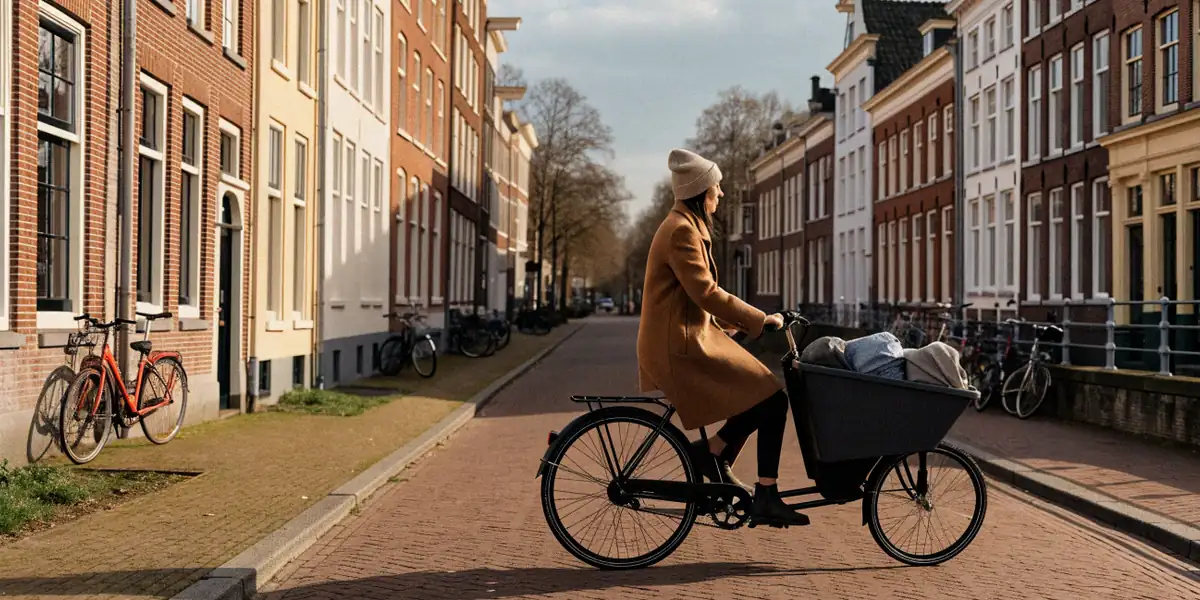
A bakfiets is a cargo bike with a wooden or plastic box mounted between the handlebars and the front wheel. Babboe, a popular Dutch brand, is everywhere in Amsterdam and Utrecht — parked outside crèches, leaning against canal railings, loaded with toddlers, groceries, a cello, a Christmas tree. The object itself is a contradiction. It is public, because you pedal it through traffic in full view of every cyclist and pedestrian in the city. It is also private, because whatever happens inside that box — the arguments, the snacks, the whispered secrets — belongs only to the people riding it. That tension between visible and hidden is the raw material of fiction.
The Bakfiets as a Mobile Stage
Think of the box as a stage and the city as the audience. Every ride is a short performance: you steer, you balance, you negotiate with tram rails and tourists. Meanwhile, a whole domestic drama unfolds centimetres behind your back. A child drops a glove. A sibling steals a snack. A stranger comments on your parenting in the direct way Dutch culture permits. We have watched a man on a racing bike applaud a toddler’s tantrum, and we have watched a woman at a crossing quietly hand back a lost shoe without breaking stride. These are entrances and exits. The bakfiets gives you a moving set, a captive cast, and a new scene every four minutes.
Sensory Details That Spark Fiction
Fiction lives or dies on specificity, and the bakfiets delivers it constantly. We keep a running list of what the morning actually feels like:
- The creak of the box when you load it unevenly, one child heavier than the other.
- Rain pooling in the canvas folds, then releasing in a cold slap when you brake.
- The smell of wet wool coats and speculaas crumbs at the bottom of the box.
- Bells — not one, but five, in different pitches, from different eras of Dutch cycling.
- The particular silence when both kids fall asleep and you realise you are pedalling a very heavy, very quiet machine.
None of these details is a plot. All of them are doors into one.
From Expat Life to Flash Fiction: A Method
Our team treats expat life in the Netherlands as a quarry, not a diary. The distinction matters. A diary records what happened. Fiction asks what it meant. Two Dutch concepts do most of the heavy lifting in that conversion: gezelligheid, the cozy conviviality that shapes how people gather, and the famous directness captured in the phrase doe normaal — “act normal.” One gives us warmth; the other gives us conflict. A scene with both is almost always a story.
Observe: The 5-Minute Daily Log
Every evening, we write for five minutes. No editing, no shaping, no attempt at meaning. Just three questions: What did we see? What did someone say? What felt strange? The log is deliberately ugly. Its only job is to catch the detail before it evaporates. After a month, patterns appear — the same neighbour, the same corner, the same argument about shoes. Patterns are where stories hide.
Distill: Finding the Story in a Single Moment
From the log, we pick one moment and ask a single question: what changed? A bakfiets breakdown is not a story. A bakfiets breakdown in a rainstorm, ten minutes before a deposition, with a child asking why the sky is angry — that is a story, because something is at stake and someone is changing. We cut everything that does not serve that change. Most of the log disappears. That is correct.
Write: Drafting a 500-Word Flash Piece
We draft fast, in one sitting, aiming for 500 words. Flash fiction rewards compression, so we follow three rough rules: enter late (start after the argument has begun), stay in one scene, and leave before the resolution fully lands. Dutch settings help here. A canal is a clock. A market is a chorus. A direct comment from a stranger can end a story better than any paragraph of reflection.
Writing Prompts from the Bakfiets Diaries
These are the prompts we return to when the log runs dry. They are built from real expat moments in the Netherlands, and each one already contains the seed of conflict.
Prompt 1: The Rainstorm Breakdown
Your bakfiets chain snaps in a downpour on a narrow street. Two children are in the box. A passing cyclist stops, assesses the situation, and says something brutally practical. Write the scene in 500 words. Do not resolve the breakdown. Resolve the relationship.
Prompt 2: The Direct Neighbor
A neighbour leans over the hedge and comments on your garden, your curtains, or your child’s coat — with total sincerity and zero malice. Your character must respond. Write the exchange as dialogue only. Let doe normaal sit just beneath every line.
Prompt 3: The Market Encounter
Albert Cuypmarkt, Saturday morning. Stroopwafels, raw herring, tulip bulbs, shouted prices. Your character recognises someone they have been avoiding. Write the encounter using at least five sensory details from the market and no more than one line of interior thought.
Craft Lessons: Turning Real Life into Short Stories
Real life is not automatically fiction. It is usually too slow, too kind, and too legally complicated. Three craft habits fix most of that.
Change the Names, Keep the Truth
We change names, hair colours, jobs, and street numbers. We keep the emotional truth: the shame, the relief, the petty triumph. Readers do not need your neighbour’s actual identity. They need the feeling your neighbour produced. Get the feeling right and the story survives the disguise.
Escalate the Ordinary
A lost glove is nothing. A lost glove on the day of a citizenship ceremony is a story. Escalation does not mean melodrama; it means consequence. Ask what this small moment costs your character, and then make them pay it in front of us.
Use Dutch Setting as Character
In our drafts, the Netherlands is never wallpaper. A canal reflects what a character refuses to say. A gezellig birthday party, with its precise circles of chairs, exposes who belongs and who does not. The weather is not atmosphere; it is an antagonist. When setting acts, plot moves.
Publishing and Sharing Your Expat Fiction
You have drafted the story. Now it needs readers. The Netherlands has a small but genuine infrastructure for English-language expat writing, and it is worth using.
Literary Magazines Open to Expat Voices
Expatica and The Dutch Review are English-language media outlets in the Netherlands that sometimes publish expat essays and fiction, and both are realistic first targets for a 500–1,500 word piece with a Dutch setting. Beyond them, submit to international flash journals, which care more about compression than about postcode. Read three issues before you submit. Match their length, tone, and formatting exactly.
Open Mics and Writing Groups in the Netherlands
Live reading changes a draft faster than any workshop. Rotterdam and The Hague both host regular English-language open mics, often in cafés and cultural centres, where five minutes at a microphone will tell you precisely which sentences work. We also recommend joining a small writing group — four to six people, monthly, with a hard page limit. Ours meets in a Utrecht café that serves very good appeltaart and has never once complained about the noise.
FAQ
Do I need to live in the Netherlands to use these prompts?
No. The prompts work for any expat setting, but the specific ones here lean on Dutch details — gezelligheid, doe normaal, Albert Cuypmarkt — so they land hardest if you have spent time here.
How long should a Bakfiets Diaries piece be?
We aim for 500 words for flash fiction and 1,500–2,500 for a short story. Our team drafts long and cuts hard; almost every finished piece is half the length of its first draft.
Is it safe to write about real neighbours and friends?
Change identifying details and keep the emotional truth. If a real person could recognise themselves from the page and feel exposed, revise. Fiction is not a weapon; it is a translation.
Where should I submit Dutch-themed flash fiction first?
Start with English-language outlets in the Netherlands such as Expatica and The Dutch Review, then widen to international flash journals. Read the publication before submitting, and follow their guidelines exactly.
The bakfiets is not just a vehicle. It is a daily invitation: notice the rain in the canvas folds, the blunt comment from a stranger, the small argument in the box behind you — then write it down before it dries. Start your own diary tonight, five minutes, no editing. The stories are already on the route.