

Writing Believable Child Characters: A Guide for Fiction Writers
Last winter, a five-year-old at our local playground in Utrecht informed us, with total seriousness, that her little brother “wasn’t born yet, he was still in the shop.” We laughed, then stopped — because that odd, logical, slightly magical sentence told us more about how a child thinks than a page of adult description ever could. Moments like that are why we keep a notebook of things children say. They are also why so many drafts fail: writers forget that a child’s mind is not a smaller version of ours. It runs on different rules. In this guide, we share what we have learned about writing young characters who feel real on the page, drawn from years of short stories, flash fiction, and quiet observation in our adopted home, the Netherlands.
Why Child Characters Often Fall Flat
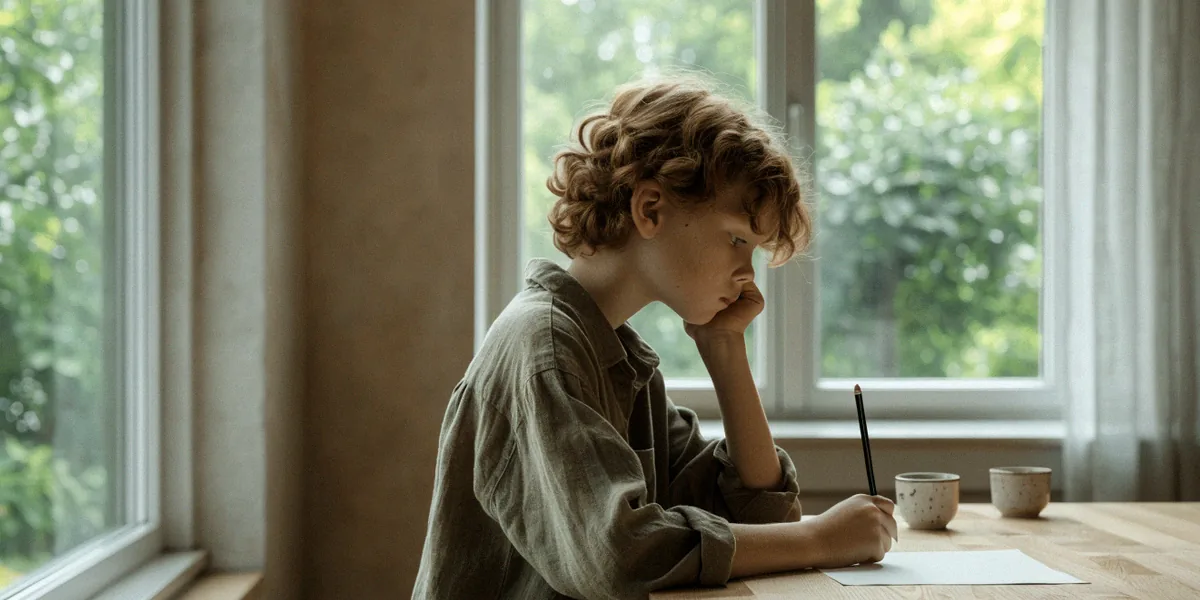
Most weak child characters fail in one of two directions. They are either miniature adults — witty, ironic, emotionally articulate — or they are reduced to cooing props with no inner life at all. Both mistakes come from the same source: writing what we remember about childhood instead of what we can observe about children. Living as expats in the Netherlands has given us an unexpected advantage here. Dutch playgrounds and schools are great places to observe children’s authentic behavior, and the mix of languages and cultures around us adds layers that a monocultural setting simply cannot offer.
The ‘Tiny Adult’ Trap
We see this constantly in workshop submissions: a seven-year-old who delivers sarcasm like a sitcom writer, or who reflects on grief with the vocabulary of a therapist. Real children can be startlingly perceptive, but their insight arrives sideways. They notice that Mum cried in the car but they explain it as “Mum’s eyes were leaking because of the onions,” even when there were no onions. The fix is not to make children stupid. It is to let their intelligence operate through limited information, strange logic, and physical detail rather than abstract language.
The ‘Baby Talk’ Cliché
The opposite failure is writing children as pure noise: “Me want cookie now!” Real speech development is messy and specific. A four-year-old might say “I goed there yesterday” — applying a rule too well, not too poorly. A bilingual child in Amsterdam might drop a Dutch word mid-sentence because it is simply the right word: “It’s not a bike, it’s a fiets, everyone knows that.” Flattening that richness into generic baby talk wastes the most interesting material you have.
Observing Real Children: A Writer’s Field Guide
If you want to write children well, you need data. Not memories — data. Our team treats observation as part of the writing practice, the same way a painter sketches hands before attempting a portrait. You do not need to be a parent. You need a bench, a notebook, and patience.
Listening to How Children Speak
Go where children actually are. Dutch playgrounds and schools are great places to observe children’s authentic behavior, and the rhythm of play is remarkably consistent across cultures. Listen for:
- Repetition used as emphasis (“It was big. Really big. Bigger than the whole sky big.”)
- Concrete comparisons drawn from their own world (“older than my teacher”)
- Sudden topic jumps that follow emotional logic, not conversational logic
- Code-switching between Dutch and English among expat and international families
- Questions that adults would never think to ask (“But who waters the rain?”)
Amsterdam and Rotterdam offer multicultural settings for character study that are hard to beat. A single afternoon at a playground in Rotterdam-Zuid can give you children speaking three languages, negotiating rules of a game with improvised sign language, and inventing a whole mythology around a broken swing.
Noticing Nonverbal Cues
Children leak emotion through the body long before they name it. Watch how a child who has lost a game stands slightly turned away, how a nervous one touches a parent’s sleeve without looking, how excitement shows up as bouncing on the balls of the feet. When you write a child character, give us the body first. The emotion will follow, and it will feel earned rather than announced.
Crafting Authentic Voice and Perspective
Voice is where observation turns into craft. A child narrator does not need to be unreliable in the gimmicky sense — they simply have a smaller map of the world, and they navigate it with total conviction.
Dialogue That Rings True
Keep sentences short but not simple. Let children answer a different question than the one asked. Let them state the emotional truth bluntly while missing the social one: “I don’t like Oma’s soup. She knows.” Writing prompts can help practice child character voice, especially prompts that force you to write only what a child could plausibly notice. Try transcribing a real conversation you overheard, then rewriting it as fiction without adding a single adult word.
Internal Thoughts and Narrative Distance
If you narrate from inside a child’s head, resist the urge to explain. A child’s internal monologue is immediate and sensory: the sting of a scraped knee matters more than the concept of mortality. If you narrate from outside, keep the distance consistent — do not dip into adult analysis halfway through a scene. Pick your camera and hold it steady.
Using Child Characters in Short Fiction and Flash Fiction
Short fiction is a natural home for young characters, because children live in small, high-stakes moments. A lost glove can be a tragedy. A first day at a Dutch school can be an epic. Flash fiction often uses child protagonists to create emotional impact precisely because their stakes are so compressed and so sincere.
Child as Protagonist
Give the child a goal that matters to them and an obstacle that matters to us. In a 500-word piece, that might be a child trying to hide a broken vase before a parent comes home — the vase is trivial, the fear is not. We have published several flash pieces on the blog where a child’s misunderstanding of an adult world drives the entire arc.
Child as Secondary Character
Children also make superb secondary characters because they puncture adult pretension. A child at a dinner party who asks why the guests are pretending to like the food can expose the whole scene in one line. Use them sparingly and they hit hard.
Avoiding Cultural Missteps in Expat Fiction
Writing children from cultures other than your own requires care, especially here. Expat families in the Netherlands often blend Dutch and international parenting styles — cycling to school in the rain at age six, but also video-calling grandparents in three time zones. That blend is rich material, but it is not yours to invent carelessly.
Researching Cultural Norms
Learn the specifics. Dutch children typically get considerable independence early — walking or cycling to school, playing outside unsupervised — which can surprise expat parents from elsewhere. If your character is a Dutch child, that independence should shape their behavior. If your character is a newcomer, their confusion about it is a story engine in itself.
Sensitivity and Authenticity
Ask yourself whose story you are telling and why. Avoid using a child’s cultural background as decoration or as a source of easy conflict. When in doubt, read work by writers from that community, and let children be individuals first, representatives second — or never.
Exercises to Develop Your Child Characters
Practice beats theory. Here are two prompts we return to often, both drawn from our writing prompts archive.
Prompt: The Lost Toy
Write a 300-word scene in which a child loses a favourite toy. Do not name the emotion. Show it only through action, dialogue, and physical detail. Then rewrite the same scene from the parent’s point of view and notice what changes.
Prompt: The New Kid at School
Write a flash fiction piece from the perspective of a child starting at a new school in a Dutch city. They speak some Dutch, but not enough. Let one small misunderstanding drive the story. Keep every sentence to what the child could actually perceive.
FAQ
How do I make a child character sound their age without making them sound simple?
Focus on logic and vocabulary rather than intelligence. A child can be brilliant while using concrete comparisons and limited abstract language. Let them reason correctly from incomplete information — that is what makes them sound young and real at the same time.
Can I write child characters if I don’t have children of my own?
Absolutely. Observation is the key skill, not parenthood. Dutch playgrounds and schools are great places to observe children’s authentic behavior, and keeping a notebook of overheard phrases will teach you more than any parenting book.
How do I handle bilingual or multicultural child characters respectfully?
Research the specific community, avoid stereotypes, and treat language mixing as a natural part of the character’s daily life rather than a punchline or a plot device. Expat families in the Netherlands often blend Dutch and international parenting styles, and that blend deserves nuance.
What length works best for stories with child protagonists?
Flash fiction and short stories suit them especially well, because children’s lives are built from small, intense moments. Flash fiction often uses child protagonists to create emotional impact in under 1,000 words.
Where can I find more exercises like these?
Our blog’s writing prompts section is updated regularly with exercises designed to sharpen character voice, including several focused specifically on child narrators and expat settings.
Believable child characters do not come from memory alone. They come from careful observation, genuine empathy, and steady practice — from sitting on a bench in a Rotterdam playground and truly listening, then going home and putting what you heard on the page. We hope these ideas and prompts give you a starting point. Pick one, write 300 words today, and see what your young character does when you stop telling them how to feel.